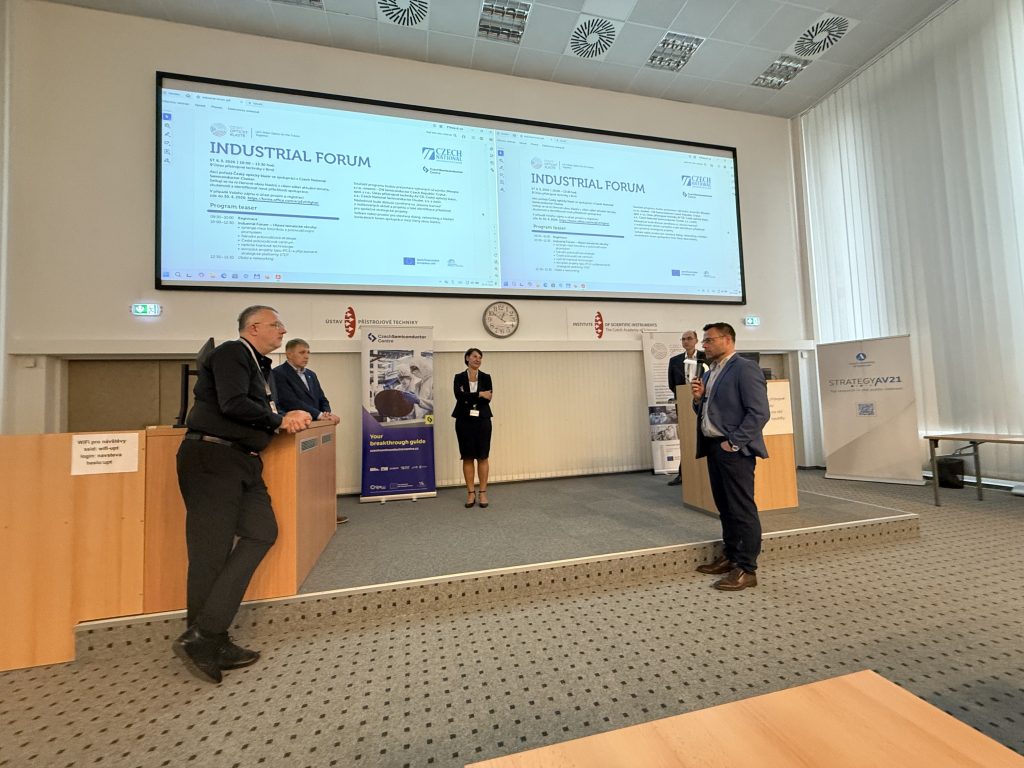


On May 6, 2026, the Industrial Forum expert meeting took place at the premises of the Institute of Scientific Instruments of the Czech Academy of Sciences. The event was jointly organized by the Czech Optical Cluster and the Czech National Semiconductor Cluster. The forum brought together representatives of research institutions, companies, and technology organizations active in optics, photonics, laser technologies, the semiconductor industry, and quantum technologies. The main topic of the event was interdisciplinary cooperation and the search for opportunities to develop the Czech semiconductor ecosystem and, more broadly, the national technology ecosystem.
The opening remarks were delivered by Josef Lazar, Director of the Institute of Scientific Instruments of the Czech Academy of Sciences and representative of the National Semiconductor Cluster. In his welcome speech, he emphasized the importance of connecting research and industry, as well as the growing significance of semiconductor and quantum technologies for the future of Czech industry.
He was followed by Petr Přikryl from the Czech Optical Cluster, who explained the motivation behind the meeting. He noted that the Industrial Forum is one of the concrete outcomes of the memorandum of cooperation between the semiconductor and optical clusters. The goal of this collaboration is to create joint projects, support know-how sharing, and strengthen the competitiveness of Czech companies and research organizations in both the European and global context. 
Michal Lorenc then spoke on behalf of the National Semiconductor Cluster. In his presentation, he outlined developments in the global semiconductor market, presented selected economic data, and discussed investment estimates that could flow into the Czech Republic in the coming years. His presentation also introduced the National Semiconductor Strategy, which defines 40 specific tasks across six key areas of development. He also provided an overview of the cluster’s member organizations and selected European initiatives involving the Czech semiconductor ecosystem. Special attention was given to the European IPCEI on Advanced Semiconductor Technologies initiative and the potential applications of laser technologies in the semiconductor industry. Participants were also invited to the upcoming Czech Semicon Days events, which will take place from May 18–22.
The morning session continued with a series of expert presentations from representatives of companies and research institutions. Libor Úlehla presented the role of Meopta in the semiconductor supply chain, while Tomáš Vaněk introduced the activities of CRYTUR and its involvement in the semiconductor industry. Mihai George Muresan from the HiLASE Centre focused on synergies between laser technologies and the semiconductor industry. Jakub Zvěřina presented the vision and technological direction of Argotech in the field of advanced packaging and photonic chips.
An interesting technological presentation was delivered by Jan Chochol from the start-up KORYMBOS Photonics, who introduced wafer-scale THz ellipsometry technology, including its potential applications for semiconductor structure analysis.
The afternoon session focused on quantum technologies. Josef Lazar presented optical quantum technologies and the National Quantum Strategy of the Czech Republic. In his presentation, he emphasized the potential of quantum applications and introduced the activities of the Institute of Scientific Instruments in the field of quantum research. He also mentioned the experimental use of a quantum computer in Ostrava, where the first practical experiments in quantum computing are currently underway.
Martin Švík from IBM followed with a presentation focused on potential applications of quantum computing and the possibilities of using IBM quantum computers in industrial and research practice. He emphasized that quantum technologies are among the segments expected to experience significant exponential growth in the coming years.
At the same time, the development of quantum computing and related applications is opening up new business opportunities that may lead to the creation of new technology companies, start-ups, and specialized services connected to the quantum ecosystem. The Czech Optical Cluster has long viewed optical and quantum technologies as one of the key pillars of its development strategy, while quantum technologies are also highly relevant to the semiconductor sector. Thanks to the connection between top-level research, industrial partners, and technology companies, the cluster is among the important players in photonics and emerging quantum technologies in the Czech Republic. The cluster actively supports cooperation between academia and industry and creates space for innovations, new projects, and international partnerships within the rapidly developing quantum ecosystem.
The final presentation of the program was delivered by Veronika Kramaříková from the University of Chemistry and Technology in Prague. She presented the European perspective on the development of quantum technologies and outlined the European Union’s requirements for the establishment and operation of clusters focused on quantum technologies. She particularly emphasized the importance of international cooperation, infrastructure sharing, and building strong European partnerships.
The Industrial Forum in Brno confirmed that connecting photonics, the semiconductor industry, and quantum technologies represents a major opportunity for both Czech research and industry. The meeting also demonstrated the growing ambitions of the Czech Republic to become an important part of the European semiconductor and quantum ecosystem. Participants agreed on the intention to establish a national quantum platform as a key entity for leveraging opportunities in the exponentially growing quantum segment. The preparation of this quantum platform will become one of the main areas of future cooperation between the optical and semiconductor clusters.